

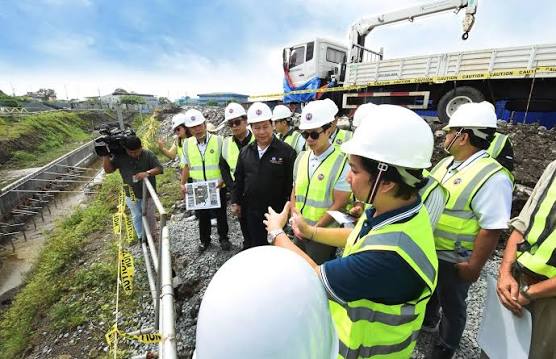
TRECE MARTIRES CITY, Cavite — The Provincial Government of Cavite is working with the Japan International Cooperation Agency (JICA) to built infrastructure projects that will help address flooding in key areas.
Eloisa Rozul, Department Head of the Office of the Provincial Disaster Risk Reduction and Management Officer (OPDRRMO), in an interview with the Philippine Information Agency – CALABARZON confirmed that the Cavite Industrial Area Flood Risk Management project will help reduce flooding in urbanized and industrial parts of the province.
“Cavite has experienced rapid urbanization over the past decades, resulting in increased paved surfaces, reduced natural drainage, and higher flood runoff during heavy rainfall.”
The project will benefit low-lying areas, particularly the cities of Bacoor and Imus, as well as Kawit, Noveleta, Rosario, and Tanza towns which experience regular flooding due to San Juan River, Imus River, and Ylang-Ylang River, as well as interconnected drainage systems leading to Manila Bay.
Moreover, Rozul noted that the provincial government is also pushing local government units to pass local legislature creating infrastructure audit teams and school safety officers to ensure the integrity and safety of public infrastructure.
“We recommended legislative measures to the Sangguniang Panlalawigan through the PDRRMC Chairperson for the enactment of DRRM-related ordinances.”
Rozul noted that key policies that they have recommended included the ordinances for the creation of an Infrastructure Audit Team, while other policies such as the Designation of Safety Offices in Elementary and Secondary School and the Ordinance on Safety Waters are being approved for first reading and are undergoing the crafting of Internal Rules and Regulations, respectively.
The Cavite Industrial Area Flood Risk Management project includes major engineering interventions, such as the construction of a Flood Retarding Basin designed to retain excess floodwater temporarily during heavy rainfall and gradually release it after the storm, thereby reducing downstream flooding. Improvements on riverbeds, floodways and diversion channels, drainage systems, and bridge networks are also underway to help reduce flooding by redirecting excess floodwater towards Manila Bay.
As the province continues to invest on flood mitigation infrastructure, the official emphasized that public support is key in strengthening disaster preparedness and recovery efforts.
“Together, we continue to improve our preparedness, response, recovery, and resilience to better protect lives, livelihoods, and the future of our province. Disasters may not always be prevented, but we can significantly reduce their impacts by working together, planning ahead, and acting responsibly.”
With some of its cities connected to Metro Manila, Cavite Province frquesntly experiencve province especially in parts of Bacoor, Imus, Kawit, Noveleta, Rosario, General Trias, Tanza, and Dasmariñas, particularly during prolonged rains, tropical cyclones, and high tide. (PB-PIA CALABARZON)