

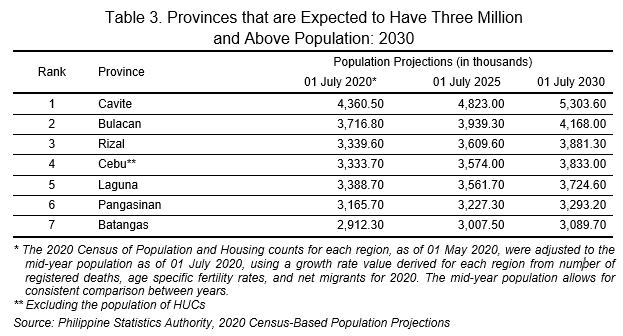
Cavite is expected to remain the most populous province in the Philippines with a projected population of 5.30 million by 2030, according to the Philippine Statistics Authority (PSA).
Bulacan will follow with 4.17 million people, while Rizal is anticipated to surpass Laguna to become the third most populous province with 3.88 million residents. Laguna is projected to reach 3.72 million by the same year.
These figures represent a significant increase from 2020 data, which recorded 4.36 million people in Cavite, 3.72 million in Bulacan and 3.39 million in Laguna.
In terms of highly urbanized cities, Quezon City will maintain its status as the largest in 2030 despite a slight projected decrease to 2.92 million from 2.96 million in 2020.
The City of Davao is expected to grow to 2.04 million, followed by the City of Manila at 1.90 million and the City of Caloocan at 1.71 million. The City of Taguig is projected to reach 1.52 million and the City of Zamboanga is expected to exceed 1 million residents.
The PSA board approved the methodologies for these 2020 census-based projections through PSA Board Resolution No. 18, Series of 2024, on Nov. 15, 2024. The projections were prepared by the PSA in collaboration with the Inter-Agency Working Group on Population Projections and technical assistance from the United Nations Population Fund Philippines.
National projections indicate the Philippine mid-year population will reach 123.96 million by 2035, adding 14.76 million people to the 109.20 million recorded in 2020.
This represents an average annual growth rate of 0.85 percent. By 2035, the male population is expected to reach 62.64 million, or 50.5 percent of the total, while the female population will reach 61.32 million, or 49.5 percent.
CALABARZON will remain the most populous area with 19.07 million people by 2035, followed by the National Capital Region (NCR) at 14.49 million and Central Luzon at 14.02 million. The Cordillera Administrative Region is expected to remain the smallest with 2.13 million residents.
Gender distribution trends show that 55 provinces and 11 highly urbanized cities will exceed the national average sex ratio of 102 males per 100 females by 2030.
Batanes is projected to have the highest ratio at 114 males per 100 females. Conversely, females are expected to slightly outnumber males in the NCR by 2035, with a ratio of 99 males per 100 females.
Growth rates across the archipelago are expected to diverge. The Bangsamoro Autonomous Region in Muslim Mindanao is projected to see its annual growth rate rise to 1.79 percent by 2035. However, the NCR is expected to see a slowdown, with its growth rate dropping to 0.40 percent in the 2030 to 2035 period.