

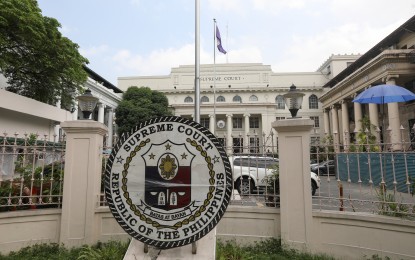
MANILA – The Supreme Court (SC) has laid down guideposts for proving who owns or controls a social media account in criminal cases.
In a 30-page decision made public Friday, the SC’s First Division affirmed the conviction of an individual, “John,” for committing psychological violence against his ex-girlfriend, “Mary,” by posting derogatory statements about her on Facebook.
John and Mary were in a relationship for three years when Mary became pregnant. He offered her marriage, but she refused because of their problems. She raised their child alone, living with her parents.
Years later, Mary’s siblings received a private message on Facebook Messenger from an account they knew belonged to John. In the message, he insinuated that Mary was causing his mother a heart attack.
The next day, Mary learned from a friend that the same account posted a statement in Kapampangan on Facebook, calling her a dirty woman and an animal, and threatening to punch her when he sees her. He repeated the insults in the comments to the post, which was public.
Fearing for her safety, Mary filed a complaint against John for violating Republic Act No. 9262 or the Anti-Violence Against Women and Their Children (Anti-VAWC) Act. A protection order was issued in her favor pending the resolution of the case.
During trial, printouts of the screenshot of the Facebook post were presented. Mary admitted she created the account long ago for John but said he had been the one using it.
Her two siblings testified that the account was John’s and they received messages from him through the same account.
John denied owning the account but identified the persons in the profile photo as himself and one of his children with his current live-in partner.
He claimed someone might have used his photo to create a fake account. John also argued he could not have made the post because he was working as a waiter at a restaurant at the time, without access to his phone.
The Family Court and the Court of Appeals found him guilty, rejecting his mere denials. Both courts noted that he and his live-in partner were able to identify the people in the profile photo.
The SC affirmed the conviction, stressing that in criminal cases, the prosecution must prove not only the elements of the crime but also the identity of the offender.
Noting that Facebook is widely used in the Philippines, the SC held that a Facebook account can easily be created by anyone claiming to be at least 13 years old with an email address or mobile number.
Given this, the SC ruled that guideposts are necessary to establish who owns or controls a social media account.
It said the following must be shown to prove ownership or access: admission of ownership or authorship; being seen accessing the account or composing the post; containing information known only to the offender or a few people; language consistent with the offender’s characteristics; records from the internet service provider, telecommunications company, or social media site, and results from device forensic analysis showing geolocation features, and other attributes linking the account to the offender; acts consistent with previous posts; or other instances showing ownership, access, or authorship.
Applying these, the SC found that several factors proved John wrote the Facebook post.
The account name bore his full name, and the profile photo showed him with his child from his current live-in partner. The post also contained statements John was expected to know, such as Mary’s nickname and the fact that he had been blocked by her.
Having established that John made the post, the SC ruled that all the elements of psychological violence under Section 5(i) were present, including the public ridicule Mary suffered.
John was sentenced to up to eight years in prison, fined PHP100,000, and ordered to undergo psychological counseling or psychiatric treatment. (PNA)